
Asphalt can go down in cold weather, but not in any cold weather, and a driveway is the hardest kind of job to pave late in the year. Tennessee’s own highway spec sets the floor at 45°F for thin layers of ordinary hot mix, and higher for some mixes. A driveway’s top layer is thin, it sits on ground that’s been cold for weeks, and it cools fast. So the honest answer for most Cookeville driveways in December and January is: wait for a warm stretch, or do the gravel and drainage work now and pave in spring.
Here’s where those numbers come from, why cold ruins a driveway that looked fine the day it went down, and what you can still get done this winter.
What Tennessee’s road spec says about cold-weather paving
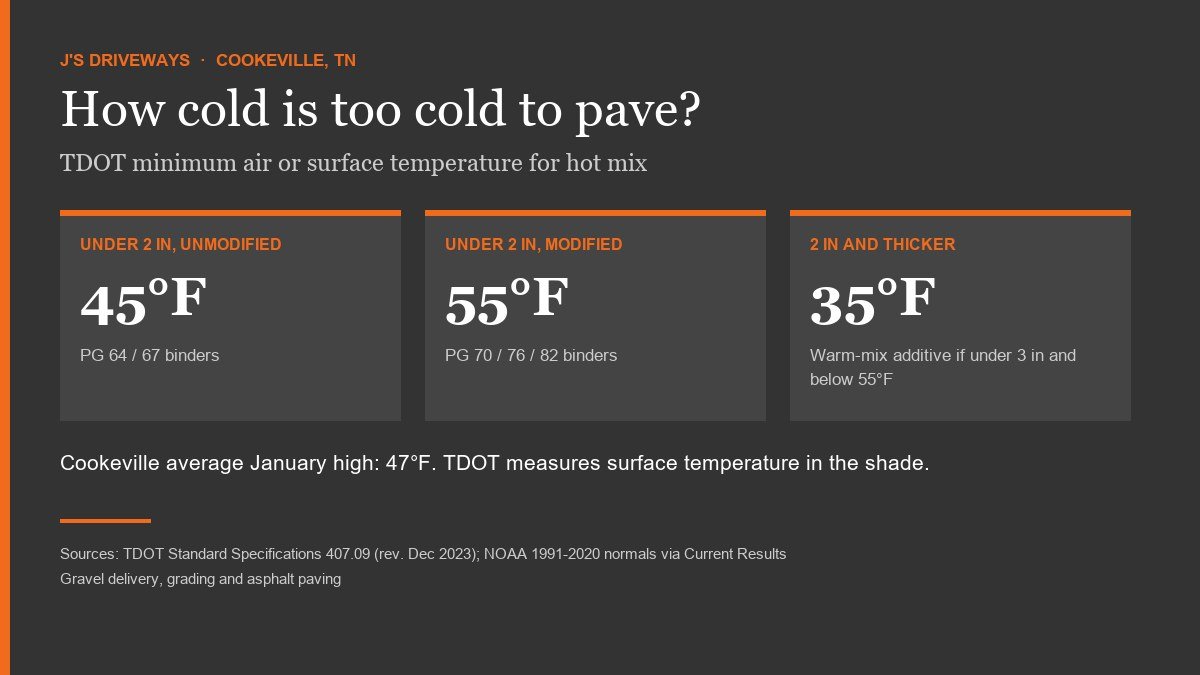
There’s no state rule for residential driveways, but the Tennessee Department of Transportation publishes the temperature limits its own paving contractors have to follow, and they’re a good yardstick. Under Section 407.09 of TDOT’s standard specifications, as revised in December 2023 (TDOT 2021 Supplemental Specifications, Section 400):
- Layers under 2 inches thick: at least 45°F for unmodified mixes (PG 64 and 67 binders) and 55°F for polymer-modified mixes.
- Layers 2 inches and thicker: at least 35°F, and if the layer is under 3 inches and it’s below 55°F, the mix needs an approved warm-mix additive.
- Surface temperature is measured in the shade. If the surface isn’t warm enough and the air is forecast to drop below the minimum within 4 hours of starting, the crew doesn’t start.
That last rule tells you how seriously the state takes it. It isn’t enough for it to be 46°F at 10 a.m. It has to stay warm long enough to finish the job right.
Why cold weather ruins asphalt that looks fine on day one
Hot-mix asphalt has to be rolled and compacted while it’s still hot. The binder stiffens as it cools, and once it’s too stiff, the roller can’t press the stone together any tighter. In cold weather that window shrinks. Cold ground pulls heat out of the bottom of the mat, wind pulls it off the top, and a thin driveway layer has very little heat to lose before it stops compacting.
Under-compacted asphalt can look smooth and black the day it’s laid. The problem shows up later. It has more open space inside it, so water gets in, and water that gets in freezes. Jack Sherrill has been saying the same thing about maintenance for years:
“Keep the cracks filled, don’t let the water in through the cracks to freeze and bust up the asphalt.”
– Jack Sherrill, J’s Driveways
A driveway paved too cold starts life with that problem built in, before it has a single crack.
What a Cookeville winter looks like on a paving calendar
Cookeville’s average January high is 47°F and the average low is 27°F (NOAA 1991 to 2020 normals, via Current Results). That average high is barely over the 45°F line for thin layers, and it’s an average, so plenty of January days come in under it. And TDOT measures surface temperature in the shade, which on a winter morning can lag well behind the air reading on your phone.
That’s why late fall and winter paving around here gets decided by the forecast, a few days at a time, not by the calendar. Some years there’s a warm, dry week in December. Some years there isn’t one until March. If a crew is pushing to pave your driveway on a 38-degree morning with a cold front coming, ask them which mix they’re using and what thickness, and hold them to the numbers above.
Driveway work you can still do in winter
Winter isn’t dead time for a driveway. A lot of the work that makes a paved driveway last happens before the asphalt:
- Gravel. A fresh load of crushed stone on a worn gravel driveway fills ruts and gets you through mud season. We deliver 610 crush and other sizes; see gravel delivery in Cookeville.
- Drainage and grading. Winter rain shows you exactly where water runs and where it sits. That’s the best time to see what a new driveway’s base needs. If your lot slopes, read building a driveway on a hill.
- Temporary pothole patches. Cold-mix patch can fill a hole to keep it from growing until spring. It’s a stopgap, not a repair.
- Planning and quotes. Getting on a schedule in winter beats calling in April with everyone else.
Sealing waits too. Sealer needs 50 degrees and rising for 24 hours, and we covered why in new asphalt driveway care.
Asphalt paving in cold weather: how to decide when to schedule your driveway
If your old driveway is failing and you need it done, a warm, dry stretch in late fall or a winter warm spell can work, with the right mix and thickness and a crew willing to call it off if the weather turns. If you can wait, spring gives you the longest compaction window and the best chance at a driveway that lasts. Not sure whether yours can make it to spring? The five signs a driveway needs repairs will help you decide, and our asphalt vs concrete comparison covers how each surface handles freeze and thaw.
Cold-weather paving questions
What’s the minimum temperature to pave an asphalt driveway?
There’s no one number for driveways. TDOT’s spec for its own roads uses 45°F for layers under 2 inches of unmodified mix and 35°F for layers 2 inches and thicker, with higher minimums for modified mixes. Those are a reasonable floor for a driveway too.
Can you pave asphalt in the winter in Tennessee?
Sometimes, on warm, dry days that stay warm through the job. Most of December through February doesn’t qualify in the Upper Cumberland.
What happens if asphalt is laid when it’s too cold?
It cools before it can be fully compacted. It may look fine at first, but it lets water in, and freeze-thaw cycles break it up sooner.
Can you seal a driveway in winter?
No. Sealer needs 50 degrees and rising for a full day, so sealing waits for spring.
Want to get on the schedule for spring, or need gravel before then? See our driveway services or get a quote. You can also call (931) 269-5882.