
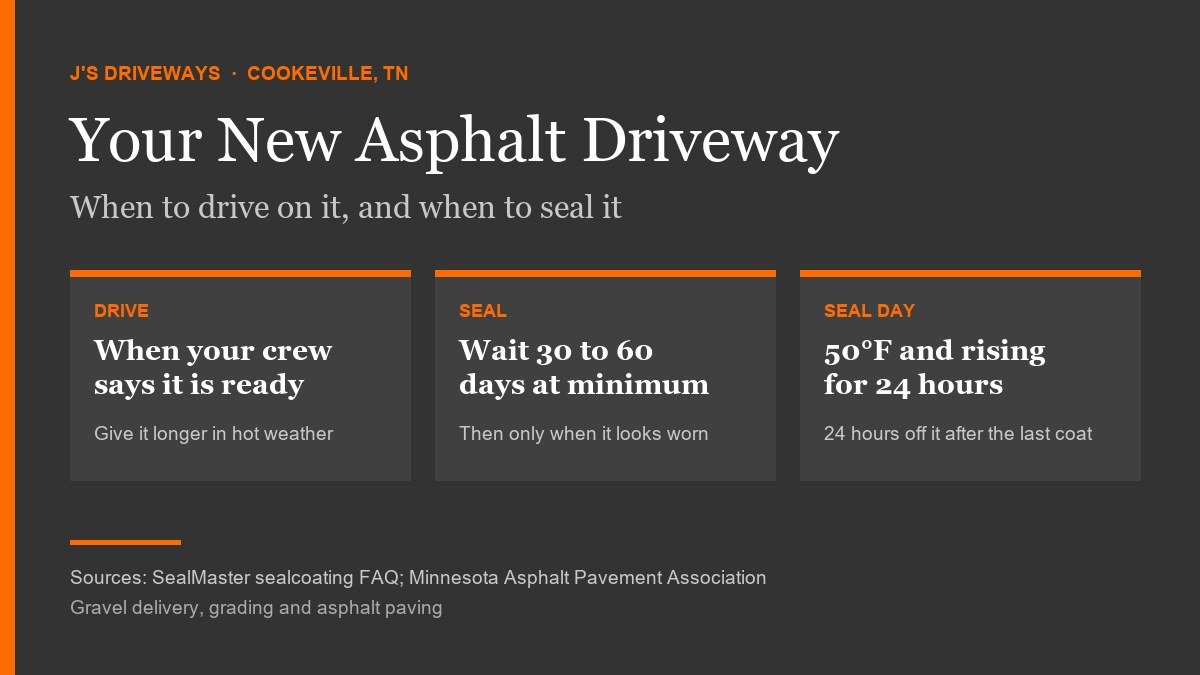
Drive on new asphalt when your paving crew says it’s ready, which depends on the mix, the thickness and the weather. Don’t seal it for at least 30 to 60 days, and on a fall paving job the first seal usually waits for spring. Those are two different clocks. The surface firms up fast. The binder inside it keeps curing for months, and that’s what decides when sealer can go on.
Here’s what to do with a new driveway in the first year, what’s normal, and what’s actually worth worrying about.
When can you drive on a new asphalt driveway?
When the crew that paved it says so, for your job. That’s not a dodge. Thickness, the mix, and the weather that week all change the answer, and nobody can give you one number that covers a cool October morning and a 95-degree July afternoon.
What you can control is how hard you lean on it early. The Minnesota Asphalt Pavement Association lists “opening parking lots to traffic within hours of final paving” among the things that make fresh asphalt scuff and dent. If the forecast is hot, give it longer than the minimum. Your driveway won’t mind the wait.
Why new asphalt marks so easily
Asphalt is held together by a binder that softens when it’s warm and stiffens when it’s cold. The same association’s care and maintenance sheet puts it plainly: the binder “gets harder as the ambient temperature goes down and gets softer as it goes up,” and the mix is designed to be flexible “to minimize cracking.”
That flexibility is why tire scuffs show up on new driveways, especially in the first summer. If you see them, here’s the part most homeowners don’t get told: the association says scuffing and tire marks are “typically an aesthetic issue that will not affect the long-term performance of the asphalt pavement.” A driveway that marks in hot weather will, in their words, have “the same life span” as one paved in cooler weather with no marks. Most marking fades under normal traffic.
Dents are a different story, because those come from weight sitting in one spot.
What to keep off it the first summer
The association’s driveway reminders and care sheet cover the usual culprits. Most of them are things you’d never think of as heavy:
- Turning the steering wheel while the car is standing still. Get rolling first, then turn.
- Motorcycle and bicycle kickstands, lawn chairs, and trailer dolly wheels. Put a block or a pad under them.
- Jack stands and car ramps, unless there’s a piece of plywood under them.
- Heavy trucks: oil delivery, concrete trucks, anything big. Keep them off the new surface.
- Campers, boats and trailers parked for weeks. Plywood under the tongue jack and the tires.
- The edges. They’re the weakest part of the driveway because nothing supports them from the side, so don’t drive on them. Building the sides up with topsoil and grass helps.
- Gas, oil, antifreeze and power steering fluid. Petroleum products dissolve the binder, so soak up a spill, flush it with the hose, and scrub it with a degreasing detergent right away.
On a scorching afternoon you can also cool the surface down with a hose before you move vehicles around. The association notes that “flooding with water to lower the mixture temperature” has been used to help prevent tire scuffing.
When to seal a new asphalt driveway
Not right away. SealMaster, the sealcoat manufacturer, says in its sealcoating FAQ that “new asphalt should cure a minimum of 30 to 60 days” before it gets sealed. That’s the floor, not the target.
The same FAQ sets two more rules that matter once you do seal:
- You need “50 degrees and rising for a 24 hour period.” Sealer applied into a cold snap doesn’t cure right.
- Keep traffic off for “24 hours after the final coat.”
Jack Sherrill has been sealing driveways since he was 12, and his test for when a driveway is ready for another coat is to look at it. In his interview about building J’s Driveways, he said: “Generally, you can see it wearing away. You’ll see areas that’s black and then areas that’s still gray and kind of spotty. When you start seeing those, it’s getting close to time.”
Sealing too often is its own problem
More sealer isn’t more protection. Jack’s warning from the same interview:
“One of the problems that a lot of homeowners have is they redo it too soon. And if you put too much sealer on, the sealer itself will start cracking.”
Jack Sherrill, J’s Driveways
And to be fair to you, the paving side of the industry is more skeptical of sealcoat than the sealer companies are. The Minnesota association’s care sheet says a well-built asphalt driveway shouldn’t need maintenance “for a number of years,” and that sealcoat earns its keep mainly by stopping raveling, where the stone starts coming loose from the surface. SealMaster’s position is that sealing “prevents oxidation of the asphaltic binder” and “adds years of life to the pavement.”
Both can be true for different driveways. What they agree on is the order of operations: let new asphalt cure first, then seal when the surface actually shows wear, not on a calendar. Cracks are the exception. Jack’s rule is to keep them filled so water can’t get in, freeze, and break up the asphalt from underneath. If you’re not sure what you’re looking at, our guide to the five signs a driveway needs repairs walks through it.
Paved in the fall? Plan the first seal for warm weather
This is the one that catches people around here. If your driveway goes down in October, 30 to 60 days of curing lands you in November or December. Whether those days actually clear SealMaster’s 50-degrees-and-rising rule is a weather-forecast question, not a calendar one.
Waiting is fine. SealMaster’s own cure rule means a fall driveway goes into its first winter unsealed anyway, and the Minnesota sheet expects a well-built one to go years without maintenance. The sensible plan is usually to look at it again in the spring and seal once it’s warm and the surface is showing some gray. If you’re still choosing between surfaces, our comparison of asphalt and concrete covers how each one holds up, and if you’re paving on a slope, read building a driveway on a hill first.
Got a new driveway and a question about it? Send us a note and we’ll take a look. And if you’ve already got scuff marks from the first hot week, leave them alone. They’ll fade.